
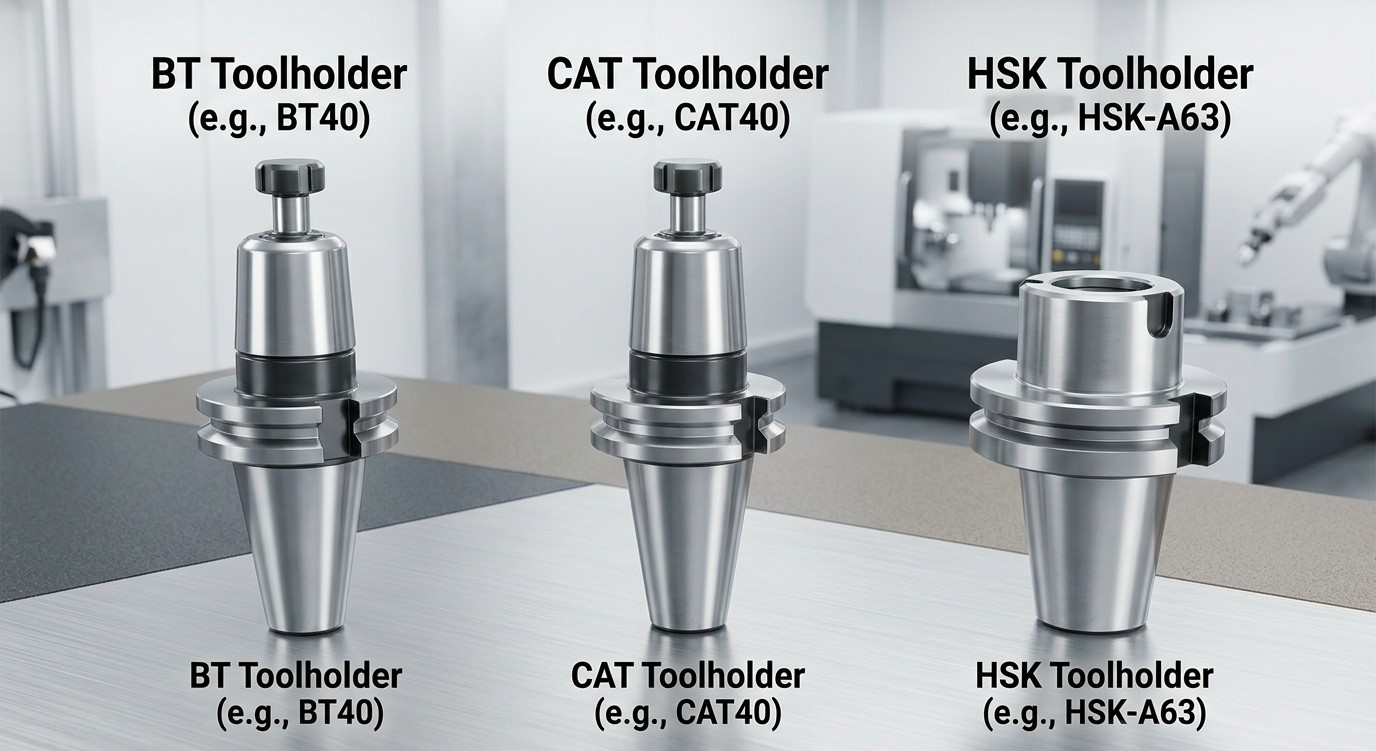
What Is the Difference Between BT, CAT, and HSK Toolholder Systems?
Choosing the right toolholder system is essential for achieving accuracy, stability, and productivity in CNC machining. The toolholder connects the cutting tool to the machine spindle, and its design affects tool retention, rigidity, machining performance, and compatibility.
Three widely used CNC toolholder systems are BT, CAT, and HSK. Although they serve the same basic purpose, they differ in taper design, clamping mechanisms, spindle contact, and typical applications.
For manufacturers seeking dependable industrial tooling solutions, Khokhawala Trading LLC, an Industrial Tools Supplier in Dubai, supports workshops and engineering businesses with tooling solutions for a variety of machining requirements.
In this guide, we explain the differences between BT, CAT, and HSK toolholder systems, their advantages, applications, and the factors to consider when choosing the right option.
Table of Contents
- What Is a CNC Toolholder System?
- What Is a BT Toolholder System?
- What Is a CAT Toolholder System?
- What Is an HSK Toolholder System?
- Key Differences Between BT, CAT, and HSK
- Advantages and Applications of Each System
- How to Choose the Right Toolholder System
- Common Toolholder Selection Mistakes
- Frequently Asked Questions
- Conclusion and CTA
1. What Is a CNC Toolholder System?
A CNC toolholder system is the interface that secures a cutting tool assembly inside a machine spindle. It must position the tool accurately, transmit machining forces, and maintain a stable connection during operation.
Toolholder systems are manufactured to specific standards. The spindle and toolholder must match in size and design to ensure proper seating and clamping.
BT, CAT, and HSK are three common systems used in CNC milling and machining centers. Selecting the correct one helps reduce setup problems and supports consistent machining performance.
2. What Is a BT Toolholder System?
BT stands for a toolholder system standardized for machining applications under Japanese industrial standards. It is widely used in Japan and across Asian manufacturing markets.
BT holders typically feature a 7:24 steep taper, a symmetrical flange design, and an external retention knob, also known as a pull stud. The machine’s drawbar pulls the holder into the spindle to secure it.
Common sizes include BT30, BT40, and BT50. The appropriate size depends on the machine spindle and the intended machining application.
Advantages of BT Toolholders
- Symmetrical design that supports good balance
- Broad availability in many Asian markets
- Suitable for a wide range of CNC milling operations
- Compatible with many automatic tool-changing systems designed for BT interfaces
- Available in different sizes for different machining requirements
Applications of BT Toolholders
BT systems are commonly used in general CNC milling, metalworking, mold manufacturing, drilling, and production machining.
They are a practical choice for workshops whose machines are specifically designed for BT interfaces.
3. What Is a CAT Toolholder System?
CAT, often called a V-flange toolholder, is a toolholding standard widely used in North American manufacturing. It uses a 7:24 steep taper, similar to the BT system, but has different interface details.
CAT holders typically use an external pull stud that engages with the machine’s drawbar. The flange also provides a gripping surface for the automatic tool changer.
Common sizes include CAT30, CAT40, and CAT50.
Advantages of CAT Toolholders
- Widely available for compatible CNC machines
- Suitable for general-purpose and heavy-duty machining, depending on size
- Established tooling ecosystem in North America
- Compatible with automatic tool changers designed for CAT holders
- Available with various tool-gripping designs, including collet, hydraulic, and shrink-fit configurations
Applications of CAT Toolholders
CAT holders are commonly found in CNC milling centers, automotive manufacturing, metal fabrication, and general industrial machining.
Larger sizes, such as CAT50, may be selected for applications requiring greater rigidity and capacity for heavier cutting tools, provided the machine is designed for that interface.
4. What Is an HSK Toolholder System?
HSK stands for Hohlschaftkegel, a German term referring to a hollow-shank taper. The HSK system was developed to provide a compact, precise spindle connection suitable for demanding machining applications.
Unlike BT and CAT holders, HSK holders use a 1:10 taper and a hollow shank. They are designed for simultaneous contact between the taper and the spindle face, commonly called dual contact.
HSK holders are clamped using an internal mechanism that engages the hollow shank rather than relying on an external pull stud.
Common variants include HSK-A, HSK-B, HSK-E, and HSK-F. These forms differ in design and intended use, so the correct type must be selected for the machine and application.
Advantages of HSK Toolholders
- Dual-contact design supports rigidity and repeatability
- Compact, lightweight construction
- Well suited to many high-speed machining applications
- Good potential for low runout with a suitable precision assembly
- Effective for demanding precision machining and some five-axis applications
Applications of HSK Toolholders
HSK systems are used in high-speed milling, aerospace manufacturing, precision mold and die machining, and other applications where rigidity and accurate tool positioning are important.
The specific HSK form, holder balance, spindle design, and machine speed rating determine suitability for a particular operation.
5. Key Differences Between BT, CAT, and HSK
The main difference lies in the interface geometry and the way each system connects to the spindle.
| Feature | BT | CAT | HSK |
|---|---|---|---|
| Common market | Asia and Japan | North America | Global precision machining |
| Taper design | 7:24 steep taper | 7:24 steep taper | 1:10 hollow taper |
| Spindle contact | Generally taper contact | Generally taper contact | Taper and face contact |
| Clamping method | External pull stud and drawbar | External pull stud and drawbar | Internal clamping mechanism |
| Common sizes | BT30, BT40, BT50 | CAT30, CAT40, CAT50 | HSK-A63, HSK-A100 and others |
| High-speed suitability | Depends on holder and machine rating | Depends on holder and machine rating | Often well suited to high-speed applications |
| Tool changer | Requires BT-compatible system | Requires CAT-compatible system | Requires HSK-compatible system |
| Typical consideration | Regional availability and machine compatibility | Regional availability and machine compatibility | Interface-specific equipment and tooling cost |
Important: BT and CAT holders are not interchangeable, even when their nominal size numbers match. Their flange and retention details differ. HSK is a different interface altogether. Always verify the exact spindle standard before purchasing a toolholder.
6. Advantages and Applications of Each System
When Should You Choose BT?
BT is a strong option when your CNC machine uses a BT spindle and you need a widely available system for general milling and production work.
Its symmetrical design supports good balance, although the achievable spindle speed depends on the holder’s construction, balance grade, tool assembly, and machine specifications.
When Should You Choose CAT?
CAT is appropriate when your machine is designed for the CAT interface. It offers a well-established tooling ecosystem and is used for both general machining and demanding cutting applications.
The holder size and design should be selected according to the machine’s capacity and the cutting forces involved.
When Should You Choose HSK?
HSK is worth considering when a compatible machine requires high precision, stable performance at elevated spindle speeds, or a compact toolholder interface.
Its dual-contact design can provide advantages in rigidity and repeatability. However, performance still depends on correct clamping, maintenance, holder quality, and machine compatibility.
7. How to Choose the Right Toolholder System
Before selecting a toolholder, consider these important factors.
Check the Machine Spindle
The machine spindle determines which interface is compatible. Check the machine documentation or spindle specifications to confirm whether it requires BT, CAT, HSK, or another standard.
Consider Spindle Speed
High-speed machining requires careful attention to toolholder balance, tool projection, and the manufacturer’s maximum operating speed. Do not assume that every holder of a particular type is rated for the same speed.
Evaluate Cutting Forces
Heavy roughing and large cutting tools may require a different holder size or design than light finishing operations. The spindle and holder must both be suitable for the expected loads.
Review Accuracy Requirements
For precision work, consider runout, tool assembly quality, spindle condition, and the repeatability of the holder interface.
Consider Tooling Availability
Check the availability and cost of compatible holders, retention components, tool-gripping accessories, and replacement parts in your market.
Account for Total Cost
Purchase price is only one factor. Tool life, setup time, maintenance, productivity, and compatibility with existing equipment also affect the overall cost.
8. Common Toolholder Selection Mistakes
Avoid these common mistakes when purchasing or using CNC toolholders:
- Choosing a holder based only on its size number
- Assuming BT and CAT holders are interchangeable
- Using an HSK holder with an incompatible spindle
- Ignoring pull-stud or retention-component specifications
- Overlooking balance requirements for high-speed machining
- Using damaged or contaminated taper surfaces
- Ignoring the machine’s tool changer requirements
- Selecting a holder without considering cutting forces and tool projection
Correct compatibility and maintenance are essential for reliable operation and safe machining.
9. Frequently Asked Questions
What is the main difference between BT, CAT, and HSK?
BT and CAT use a 7:24 steep taper with an external retention system, while HSK uses a hollow 1:10 taper with internal clamping and dual contact between the holder and spindle.
Are BT and CAT toolholders interchangeable?
No. Although both use a 7:24 taper, their flange and retention details differ. A BT holder should not be used in a CAT spindle, or vice versa, unless the machine and tooling manufacturer explicitly specifies a compatible solution.
Why is HSK used for high-speed machining?
HSK’s hollow-shank and dual-contact design can provide good rigidity and repeatability at elevated spindle speeds. Actual performance depends on the HSK form, holder balance, machine specifications, and complete tool assembly.
Which toolholder system is best for CNC milling?
There is no universal best choice. The correct system is the one designed for the machine spindle and suitable for the cutting forces, spindle speed, accuracy, and production requirements.
What do BT40 and CAT40 mean?
BT40 and CAT40 identify different toolholder interface standards and sizes. The shared number does not mean they are interchangeable.
What does HSK-A63 mean?
HSK-A63 identifies an HSK holder in Form A with a nominal 63 mm interface size designation. Compatibility must still be confirmed against the machine’s specific spindle requirements.
How can I improve toolholder performance?
Keep contact surfaces clean, inspect holders regularly, use compatible retention components, minimize unnecessary tool projection, and follow the manufacturer’s specifications for balance, speed, and maintenance.
10. Conclusion and CTA
BT, CAT, and HSK toolholder systems each offer benefits for different CNC machining environments. BT is widely used in Asian manufacturing markets, CAT is common in North American machine shops, and HSK is particularly valued for its dual-contact design and suitability for many high-speed precision applications.
The right choice depends first on the machine spindle interface, followed by machining requirements, spindle speed, accuracy, tooling availability, and total operating cost. Selecting a compatible toolholder helps maintain machining stability and prevents avoidable setup problems.
For industrial tooling solutions, Khokhawala Trading LLC can help workshops and manufacturers identify tooling options suited to their operational needs. As an Industrial Tools Supplier in Dubai, Khokhawala Trading LLC supports businesses seeking practical tooling solutions for CNC machining and industrial production.
Need the right CNC toolholders for your machine? Review your spindle specifications, choose the correct interface, and invest in tooling that supports reliable, accurate, and productive machining.