
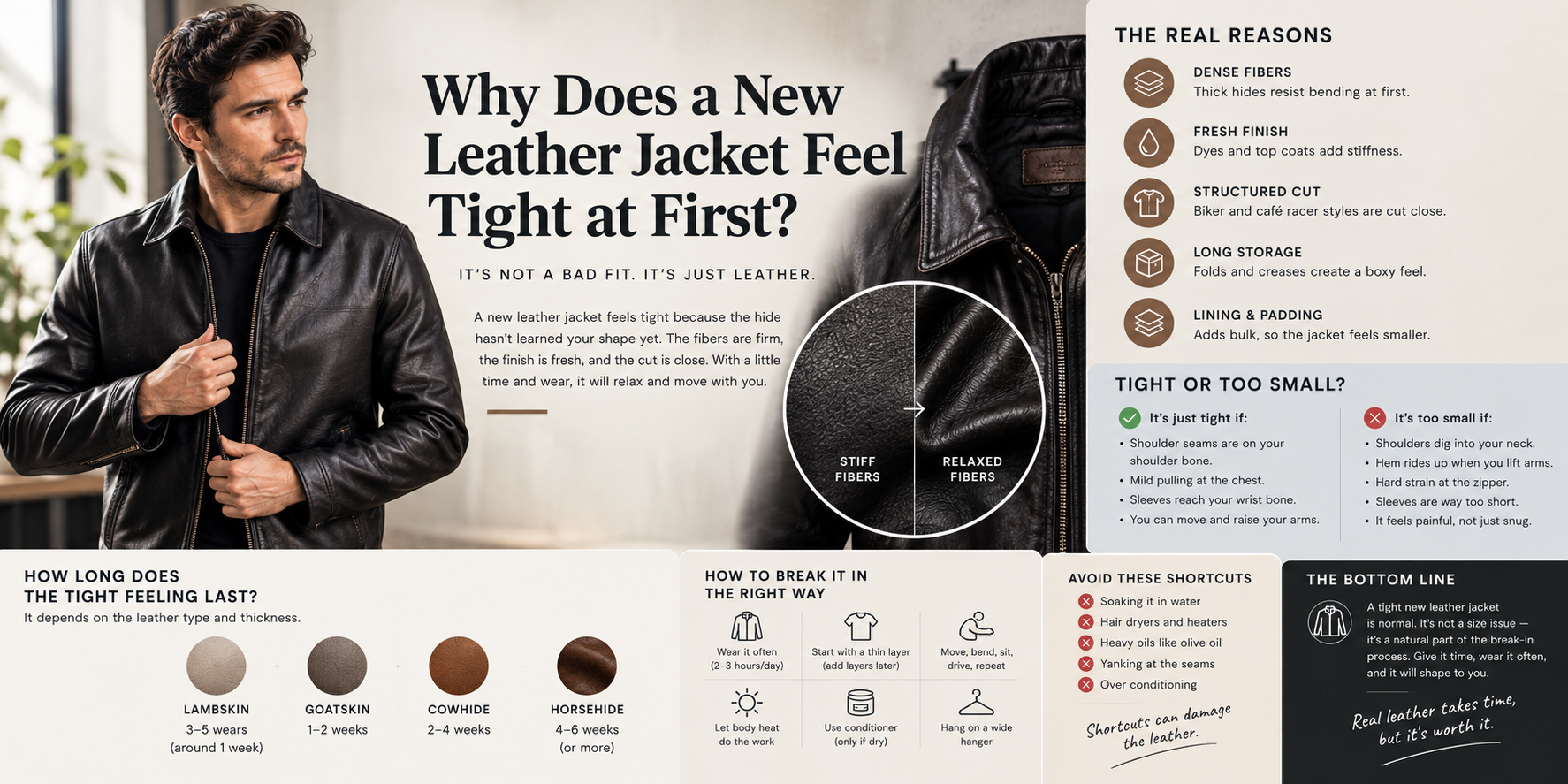
Why Does a New Leather Jacket Feel Tight at First?
You zip up a brand new leather jacket. The shoulders feel stiff. The sleeves grab your arms. The chest feels a little snug. Now you wonder if you ordered the wrong size.
Most of the time, you didn’t. So why does a new leather jacket feel tight at first? Because the hide hasn’t learned your shape yet. That’s all it is. Leather is a natural material, and it needs time to settle.
This guide explains what’s going on inside the leather, how long the tight phase lasts, and what you can do about it. We’ll also look at how to tell “tight” from “too small,” because those are two very different problems.
What Makes a New Leather Jacket Feel Stiff and Snug
Leather starts as animal skin. Tanners treat it so it won’t rot. Then it gets dyed, pressed and finished. After all that work, the fibers sit packed together and flat.
They’ve never bent at your elbow. They’ve never stretched across your back. So the jacket holds its factory shape and pushes back a little when you move.
That’s normal. Body heat and daily movement slowly relax those fibers. Every wear adds a bit of give. You won’t notice it hour to hour, but you’ll notice it week to week.
Five Reasons Your New Jacket Feels Tight
- Dense fibers: Full grain leather is strong and tightly packed. Thick hides resist bending at first.
- Fresh finish: Dyes and top coats add stiffness that eases with use.
- Structured cut: Biker and café racer styles are cut close on purpose. The shoulder line stays sharp.
- Long storage: A jacket folded in a box for months holds creases and a boxy, locked feel.
- Lining and padding: Quilted or fitted linings add bulk inside, so the jacket feels smaller than it is.
Is It Tight or Is It Too Small?
Not every snug jacket needs a waiting period. Some just don’t fit. Run this quick check before you start wearing it around the house.
- Shoulder seams should land on the edge of your shoulder bone. If they dig toward your neck, it’s too small.
- Raise your arms to chest height. The hem shouldn’t ride far above your belt.
- Zip it all the way up. Mild pulling at the chest will ease. Hard strain won’t.
- Sleeves should reach your wrist bone. A touch short is okay, because leather gives mostly in width and only a little in length.
- Test it over what you’ll really wear, like a tee or a thin knit.
If two or more of these fail, don’t wait it out. Exchange it for the next size.
How Long Does the Tight Feeling Last?
It depends on the type of leather, the thickness and how often you wear it. These are general rules of thumb. Makers vary.
- Lambskin: about 3 to 5 wears, or roughly one week of regular use
- Goatskin: about 1 to 2 weeks
- Cowhide: about 2 to 4 weeks
- Thick horsehide or heavy full grain: 4 to 6 weeks, sometimes more
- Most jackets feel noticeably better after roughly 10 to 20 hours of wear
- Lambskin usually runs about 0.6 to 0.9 mm thick, while cowhide often sits around 1.0 to 1.4 mm
- Leather gains only a small amount of give, usually well under an inch across the chest and back
Thickness is the big one. A thicker hide holds its shape longer, so it feels tight longer. It also tends to last longer. That’s a fair trade.
How Do You Break In a Leather Jacket the Right Way?
People ask this all the time: How do you Break In a Leather Jacket without stressing the seams or hurting the finish? The short answer is slow and steady. Skip the shortcuts. Here’s the routine that works.
- Wear it at home first. Two to three hours a day is plenty.
- Start over a tee or thin knit. Add thicker layers later.
- Move your arms. Reach, bend, sit and drive. This works the elbows and shoulders, where the stiffness hides.
- Let body heat do the work. Warm leather is flexible leather.
- Use a light leather conditioner once, and only if the hide feels dry.
- Hang it on a wide, shaped hanger. Never a wire one, never a hook.
- Repeat daily for the first two weeks, then wear it normally.
Short, regular wear beats one long day. Think of it like new boots. You wouldn’t hike ten miles on day one.
Shortcuts That Can Hurt the Leather
Someone online will always suggest a fast fix. Most of them cause damage you can’t undo.
- Soaking it in water: Wet leather can dry stiff and crack.
- Hair dryers and heaters: Direct heat strips natural oils and shrinks the hide.
- Heavy oils like olive oil: They leave dark stains and a sticky feel.
- Yanking at the seams: Seams are the weakest point on any jacket.
- Over conditioning: Too much product softens the shape and weakens the leather.
If a shortcut sounds too good to be true, it probably is. Leather rewards patience.
What Leather Jacket Black Does Differently
Two jackets with the same size tag can fit very differently. Cut, hide and lining all change the feel. Here’s a plain comparison.
- Hides chosen for a softer hand, so the first wear feels less rigid
- Patterns cut with room in the shoulders and arms for real movement
- Clear size charts with chest, shoulder and sleeve measurements
- Linings that add warmth without extra bulk
- Finishes made to age well instead of crack
Typical fast fashion leather:
- Thin or split leather under a heavy coat of polish, stiff first and brittle later
- Tight cuts that stretch the wrong way and sag
- Generic S, M and L sizing with little guidance
- Thick synthetic linings that make the jacket feel boxy
- Finishes that peel over time
Fit still comes first. Always check the size chart before you order. A well made jacket should feel snug, not painful.
Final Thoughts
So, why does a new leather jacket feel tight at first? Stiff fibers, a fresh finish and a close cut all need time to relax. That’s a sign of real leather, not a sign of a bad purchase.
Give it two to four weeks of regular wear. Skip the hacks. Keep it conditioned lightly and hang it well. If the shoulders and chest still fight you after that, the problem is size, not stiffness. Swap it and move on.
FAQs
Will a tight leather jacket stretch out?
Yes, a little. Leather gives mostly in width, and usually by well under an inch. It won’t fix a jacket that’s a full size too small.
How long should I wear a new leather jacket to loosen it?
Plan on 10 to 20 hours of wear. Spread that over one to four weeks, depending on the leather type and thickness.
Does lambskin soften faster than cowhide?
Usually, yes. Lambskin is thinner and softer from day one. Cowhide is tougher, so it needs more wear to relax.
Can conditioner make a tight jacket fit better?
A light coat helps dry leather flex. It won’t change the size. Use a small amount and don’t repeat it too often.
Should I size up if my new jacket feels tight?
Only if the shoulder seams dig in or the zipper strains hard. Mild snugness in the chest and arms is normal and fades with wear.